
Kingfisher Projected and Actual Release
Oklahoma uses Projected Release Date, or PRD, for ODOC's estimated prison-release date. The Pardon and Parole Board does not calculate it. Credits, programs, misconduct, sentence changes, and other legal controls can move the projection. An actual release date is retrospective. It records when the person physically left a facility or moved to another form of custody. A PRD cannot prove that departure occurred.
The initial parole eligibility date is different again. It identifies when a case may be considered for parole under the governing law. Eligibility does not promise favorable action. A parole grant may still precede release while conditions, paperwork, a home offer, another hold, or required final action remains. Final discharge comes later if supervision continues after prison release.
A person held before trial at the Kingfisher County Justice Center has no ODOC sentence calculation merely because a charge is pending. Bond payment, a signed court order, and physical departure are separate events. Another agency's hold can also prevent community release. For a county detainee, the jail record and court order are the correct path.
Find Kingfisher Projected Release Dates
Begin by sorting the record into county jail, state prison, supervision, or another custody system. The OK Offender search covers ODOC correctional and supervision data. It does not cover every short Kingfisher County jail stay. Search by ODOC number when possible. With a name search, compare the middle name, age or birth details, physical traits, offense, and linked case before selecting a result.
- Identify the custody system. Ask whether the person is at the Justice Center, in ODOC custody, on supervision, or held by another agency.
- For ODOC, inspect the live result. Record the exact label, status, facility or office, offense, sentence facts, and any public date shown. Do not rename the field.
- For a county case, obtain the judgment. Search OSCN by Kingfisher County case number or name, then obtain official proof from the Court Clerk when needed.
- Request the calculation inputs. Seek the judgment and sentence, jail-time statement, and the relevant ODOC calculation or release document instead of using an unofficial calculator.
- Confirm the event. For past release, use the certificate of release, discharge notice, termination summary, or Kingfisher jail release or movement record.
The public result must be read field by field. The live application can change, so preserve each label exactly and avoid filling a blank with an assumption. These research-backed fields are the core identity and sentence checks:
| Field | How to use it |
|---|---|
| Name and ODOC number | Establish the state record and separate people with similar names. |
| Physical description | Support identity comparison without treating appearance alone as proof. |
| Facility or supervision office | Distinguish confinement from a community supervision assignment. |
| Offense and sentence information | Compare the state record with the Kingfisher judgment and case. |
| Status | Read the exact term; incarcerated, supervised, inactive, and discharged are not interchangeable. |
| Public date label | Identify whether it refers to reception, parole, release, discharge, or another event. |
The current ODOC entry screen shows the state search route used for an ODOC-sentenced person. The official OK Offender application is pictured below.
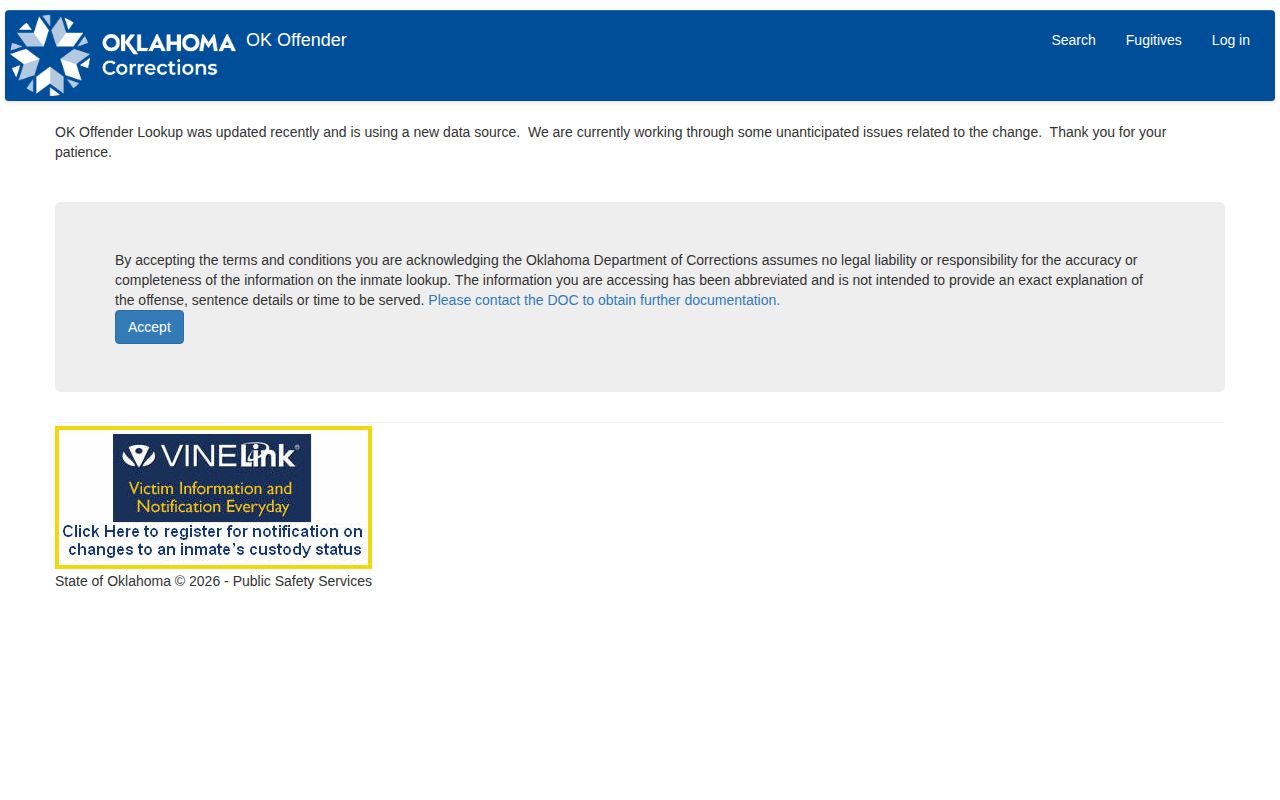
The screen is an entry point. A matched detail must be read in context, and its public labels may differ from internal sentence-calculation terms.
Note: Absence from the Kingfisher jail roster cannot show whether a person was released, transferred, or moved under another hold.
Kingfisher ODOC Date Access Conflict
ODOC public materials create a crucial limit. Its Offender Info FAQ says an inmate's release date is confidential and is not furnished without a demonstrated legitimate need, such as a judicial or law-enforcement need. It directs victims with release concerns to ODOC Victim Services. The incarcerated person receives a monthly days-remaining figure and may calculate a tentative date or ask a records officer or case manager.
At the same time, ODOC policy OP-030117 describes Offender Lookup as a source for offense data, a projected release date, a photo, and related details. These statements should not be forced into a promise that one precise internal future date is public. Inspect the live result for the exact field available. If no date appears, do not infer one or use a third-party calculator to fill the gap. Public access, internal calculations, and notice rights are separate issues.
Victims with date or movement concerns may contact ODOC Victim Services at (405) 425-2607 or victim.services@doc.ok.gov. Oklahoma VINE can supply participating custody alerts, but it is not the ODOC sentence worksheet. The Kingfisher County VINE inmate check explains how an alert should be matched to the source agency's record.
Kingfisher Release Credits and Calculations
ODOC's sentence-and-credit guide starts with the imposed incarceration term and the sentence beginning or reception calculation. Administrators convert that span to days remaining. Each month, they reduce the balance for time served and credits earned, or increase it when credits are lost. A sentence reaches discharge when the controlling balance reaches zero, subject to all judgments, sentence sequences, and holds.
Basic monthly earned-credit levels listed by ODOC are Level 1 at zero days, Level 2 at 22, Level 3 at 33, Level 4 at 44, enhanced Level 3 at 45, and enhanced Level 4 at 60. Achievement credits may follow approved programs or goals under 57 O.S. § 138. Meritorious credits may be awarded under § 138.1. Discipline can forfeit credits, and restoration is discretionary. The class level and award record, not a flat subtraction guessed from the sentence, control the estimate.
Oklahoma's principal 85% rule is 21 O.S. § 13.1. For listed offenses committed on or after March 1, 2000, at least 85% of the imprisonment term must be served before parole eligibility, and credits cannot reduce confinement below that floor. Credits may still accrue during the first 85%. The current statutory offense list and offense date matter. A casual label such as “violent” is not enough, and other offense-specific restrictions may apply.
- Projected Release Date
- ODOC's estimated prison-release date based on the current sentence calculation.
- Earned credit
- Days applied under Oklahoma law and ODOC rules for eligible class levels or achievements.
- Parole eligibility
- The earliest point at which parole may be considered, not a release promise.
- Detainer
- A request or hold from another authority that may prevent community release.
- Discharge
- The formal end of a sentence or supervision shown by the controlling record.
Note: Section 138 explains credits, while Section 13.1 sets a mandatory floor for the offenses and dates it covers.
Kingfisher Jail Credit Court Path
Kingfisher County jail credit depends on the controlling judgment and ODOC records. Pre-sentence jail time applies when the sentencing court orders it. For a person sentenced to ODOC, qualifying post-sentencing county-jail days are deducted under 57 O.S. § 138. ODOC also describes deferred-reception credit for an ODOC-sentenced person who remains in county jail while awaiting reception, calculated under the agency's stated class method.
The exact Kingfisher path is practical. Obtain the judgment and sentence from the Kingfisher County Court Clerk, then obtain the jail-time statement or custody dates from the Kingfisher County Sheriff's Office. If the person entered ODOC custody, ask ODOC how those records were applied to the sentence calculation. A public viewer should not decide which dates qualify or attempt to rebuild the calculation from booking dates alone.
The Sheriff does not publish a projected-date calculator or an official recent-release feed. For a person serving only a county term, use the Justice Center detention page and call (405) 375-4232 for current status. Request the existing booking/release sheet, jail-register entry, or movement record through the official sheriff contact route. A court order may authorize release, yet the jail event timestamp is the proof of physical departure.
Why Kingfisher Release Dates Change
A valid PRD can move after it is first calculated. Some changes affect the days-remaining balance. Others prevent release even when one sentence reaches its expected end. Read the current calculation with all sentences, court orders, and holds instead of treating one date as the gate appointment.
| Change | Effect on the date | Record to check |
|---|---|---|
| Earned-credit level or achievement | May reduce days remaining when authorized | ODOC earned-credit report |
| Discipline or credit restoration | May add days back or later restore some credit | ODOC disciplinary and credit calculation |
| Kingfisher jail credit | May reduce the balance when ordered and applied | Judgment, jail-time statement, ODOC calculation |
| Court correction or modification | Can alter the controlling term or sentence start | Filed court order and updated ODOC record |
| Concurrent or consecutive sentence | Changes how multiple terms overlap or follow | All judgments and sentence sequence |
| Parole action | May create a supervised release path before PRD | Board result, final action, parole certificate |
| Detainer or other hold | May cause transfer instead of community release | Warrant, detainer, movement, and receiving-agency record |
Transfer is not community release. If the Justice Center sends a person to ODOC, another county, federal custody, or immigration custody, the county event ends but confinement may continue. For an already released person, the best proof is the final release certificate, jail movement record, discharge notice, parole certificate, or termination summary. An old projected date should never replace those records.
Confirm Kingfisher Actual Release Dates
Use the agency that created the event. The Justice Center record establishes a county release or transfer. ODOC establishes state-prison release and later discharge. A court docket explains the legal order but may not state when the person crossed the facility exit. VINE may send a prompt after a participating status update, but a no-match is not proof of release and an alert is not a certified record.
For a past ODOC event, request a certificate of release, discharge notice, termination summary, parole certificate, or final disposition report through the ODOC Open Records Request form. Include the commitment name, ODOC number, birth date, and Kingfisher case. Closed Records can be reached at (405) 425-2691. For a county event, request the existing release or movement record from the Sheriff rather than asking staff to calculate a future date. Preserve the agency's exact date label so an estimate is not mistaken for completed release.