
Kingfisher Transfers Enter Oklahoma DOC
The Oklahoma Department of Corrections is a statewide correctional system. It does not operate a prison verified within Kingfisher County. Its role begins when a court commits a person to state custody or places a qualifying sentence under ODOC supervision. A transport out of the Kingfisher County Justice Center for ODOC reception is therefore a transfer. It is not a release to the community. The county movement record should name the receiving authority, and the later state record should document the prison or supervision phase.
This difference prevents a common error. A missing name on a county roster only shows that the person is no longer displayed there. It cannot tell whether the person posted bond, completed a county sentence, entered treatment, went to another county, or moved into state custody. The Kingfisher County released-inmate search and record path starts with the county event. Use ODOC only after a state sentence, transfer, or supervision connection is plausible.
A transfer to ODOC ends the county-jail stay but does not mean the person left government custody.
Search Oklahoma DOC Release Status
The official OK Offender search covers people in ODOC correctional and supervision data. It is not an archive of every person booked at the Kingfisher County Justice Center. A short county-jail stay that never led to an ODOC sentence or supervision may produce no state result. When an ODOC number is known, it is the best search key because names and aliases can create several possible matches.
- Open OK Offender and search by ODOC number when possible. Otherwise, enter the name with conservative spelling.
- Compare the middle name or initial, age or birth information, physical description, photograph, offense, and case context shown.
- Read the status, facility, supervision association, and each date by its exact label. Do not treat release, parole, discharge, and inactive as synonyms.
- Record the date the search was checked. State custody and supervision details can change.
- Request the underlying release or discharge document when formal proof is needed.
The official ODOC search form shows how the statewide lookup begins.
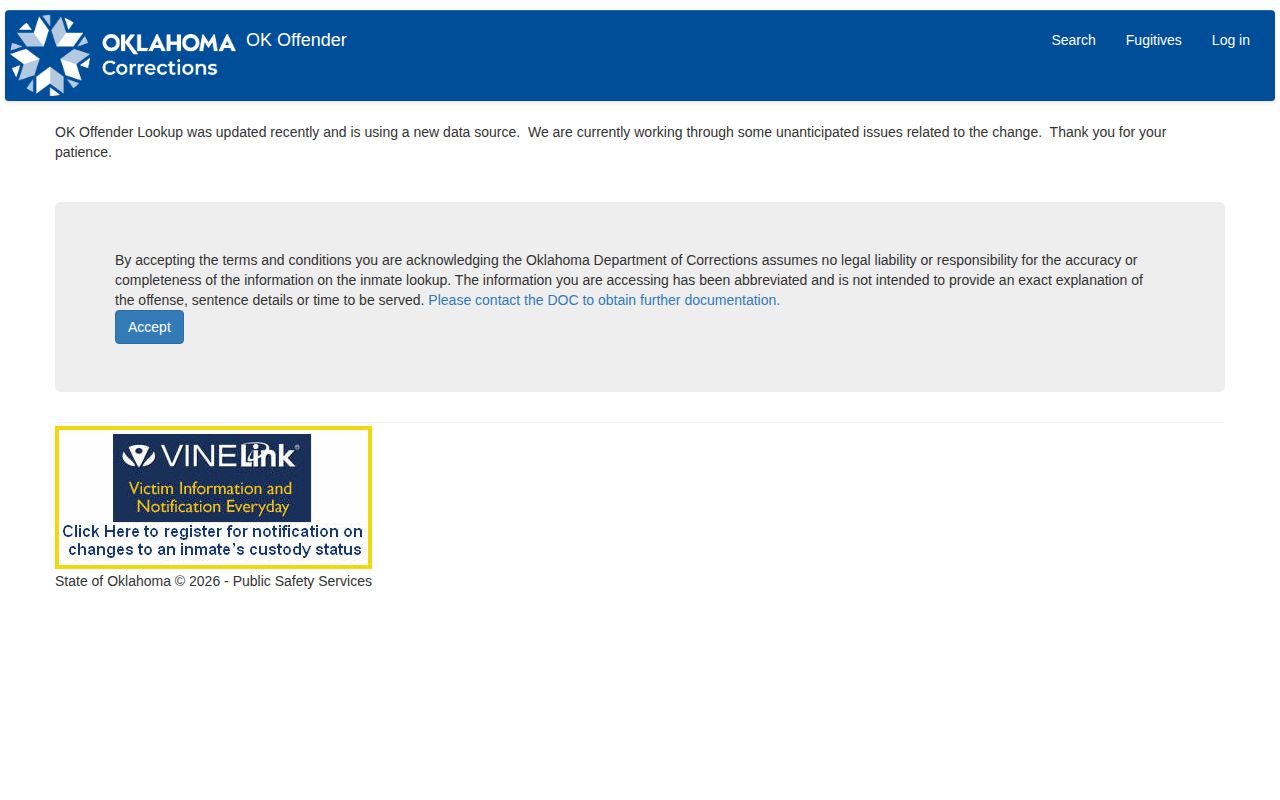
The public form is an entry point, not the final release certificate. Match more than a name before relying on a result.
Oklahoma DOC Release Record Fields
A public result may contain enough detail to separate two people and understand the broad state status. The live application controls the exact labels. ODOC materials describe identity, offense, sentence, location or supervision, status, and a photograph as common parts of the state record. Any date must be tied to the label beside it.
| Field | How to read it |
|---|---|
| Name and ODOC number | Primary identity and state record key; compare both with the Kingfisher case. |
| Facility or office | May show prison placement or a probation and parole association. |
| Status | Read the displayed term exactly; inactive, discharged, supervised, and confined have different meanings. |
| Offense and sentence | Connect the state record to the proper judgment without treating an allegation as a conviction. |
| Date fields | Sentence start, reception, parole, projected release, actual release, and discharge dates answer separate questions. |
| Photograph | An ODOC image can aid identity, but it may not be the Kingfisher County booking photo. |
A state supervision entry can mean institutional custody has ended while ODOC jurisdiction remains active. Final discharge is the later point when that jurisdiction ends. If the result is unclear, ask for a certificate of release, discharge notice, termination summary, parole certificate, or final disposition report instead of guessing from one label.
Note: A public ODOC photograph identifies a state record; it does not prove the outcome or release date of a Kingfisher County charge.
Oklahoma DOC Release Versus Discharge
Release and discharge describe different stages. A person paroled from an institution has been released from confinement under conditions, but the sentence remains active. Probation can also place a person in the community under court-ordered terms. Final discharge means the custody or supervision period has ended. ODOC policy says a field file remains active until discharge from custody or supervision, then moves to Closed Records.
| State | Custody meaning | Best evidence |
|---|---|---|
| Confined | The person remains in an ODOC institution or placement. | Current ODOC status and facility association |
| Released to supervision | Prison confinement ended, but parole or probation duties remain. | Parole certificate, reporting instructions, or supervision record |
| Discharged | The relevant ODOC custody or supervision term has ended. | Discharge notice or termination summary |
| Transferred | Control moved between agencies or placements. | Movement record and receiving-agency record |
The locally listed ODOC supervision office is at 123 West Miles in Kingfisher. It helps with supervision-office navigation after a qualifying state release. It is not the place to verify an ordinary jail-only release from the county Justice Center. Assignment can also change with residence, interstate supervision, or other case facts.
ODOC policy also describes how the file follows the person's legal status. After release to probation or parole, the record goes to the appropriate supervision region within five working days. The file stays active through custody or supervision and is transferred to Closed Records after final discharge. Original identity documents held by ODOC are returned at discharge or parole. These are state-system procedures. They should not be presented as a Kingfisher County jail property policy.
Oklahoma DOC Projected Release Dates
Oklahoma calls the estimated prison-release date a Projected Release Date, or PRD. ODOC calculates it from the imposed sentence, sentence beginning or reception rules, time served, credits earned or lost, and controlling judgments. The balance changes as credits and discipline are posted. Detainers, court changes, consecutive sentences, parole action, and jail credit can also move the estimate.
Public access has a real limit. ODOC's Offender Info FAQ says an inmate's release date is confidential without a demonstrated qualifying need, while ODOC policy describes Offender Lookup as a place that can include a projected date. These statements should not be forced into a promise. Inspect the live result for the exact public field, but do not assume ODOC will disclose an internal tentative date. Victims with release concerns may contact ODOC Victim Services through Offender Info.
A PRD is also distinct from initial parole eligibility. Eligibility allows consideration; it does not guarantee Board approval or physical release. For a completed event, an actual release certificate or discharge record is stronger than an old estimate.
Note: Treat any publicly displayed projected date as an estimate and preserve its label; it is not proof of physical release.
Request Oklahoma DOC Release Proof
ODOC offers an online Open Records Request form. A focused request should identify the commitment name, ODOC number, date of birth, and Kingfisher case. Then name the existing document that answers the question. Useful targets include a certificate of release, parole certificate, discharge notice, termination summary, final disposition report, or record sufficient to show the date and type of release.
- Match the ODOC record to the person and Kingfisher case with at least two identifiers.
- Choose the narrow document or date range needed instead of asking for every file.
- Submit the official form and ask for an estimate before charges are incurred.
- If part is withheld, request the legal basis and any reasonably separable public portion.
- For an inactive state file, contact ODOC Closed Records at (405) 425-2691.
ODOC policy states that copies may cost $0.25 per page, but an estimate is still wise because the policy rate may not describe every possible cost. Inactive files are kept indefinitely in Closed Records, subject to approved digitization and records-management practices.
Pair Oklahoma DOC and Kingfisher Records
The strongest account often uses two records. The Kingfisher County jail channel leads to the movement entry showing when the person left the Justice Center and where the sheriff sent them. The ODOC record shows what happened after state reception. If a court order caused the move, OSCN Docket Search can supply public docket context, while the Kingfisher County Court Clerk directory identifies the office that holds the official district-court record.
A state result cannot fill every county gap. It may not show the actual gate time at the Justice Center, the original local booking image, or a municipal-court event. Likewise, a county release sheet cannot prove final ODOC discharge years later. Keeping both record systems in their proper role protects against false conclusions from a single missing name or stale page.
Note: OSCN supplies a convenient public court display, but certified proof must come from the Kingfisher County Court Clerk.
Oklahoma DOC Release Contacts
Use the statewide ODOC Offender Info page for agency routes and the Probation and Parole Services directory for the Kingfisher office listing. Closed Records handles archived state files. The local Justice Center remains responsible for its own booking, release, and movement entries.
Kingfisher Probation and Parole Office
123 West Miles
Kingfisher, OK 73750
(405) 538-4124
The office is a local supervision path, not a general county jail records desk. For the original county custody episode, use the Kingfisher County Justice Center release-record route.